- English
- Español
- Português
- русский
- Français
- 日本語
- Deutsch
- tiếng Việt
- Italiano
- Nederlands
- ภาษาไทย
- Polski
- 한국어
- Svenska
- magyar
- Malay
- বাংলা ভাষার
- Dansk
- Suomi
- हिन्दी
- Pilipino
- Türkçe
- Gaeilge
- العربية
- Indonesia
- Norsk
- تمل
- český
- ελληνικά
- український
- Javanese
- فارسی
- தமிழ்
- తెలుగు
- नेपाली
- Burmese
- български
- ລາວ
- Latine
- Қазақша
- Euskal
- Azərbaycan
- Slovenský jazyk
- Македонски
- Lietuvos
- Eesti Keel
- Română
- Slovenski
- मराठी
- Srpski језик

How Does a Hybrid Stepper Motor Work?
Article Summary
Motion control systems require high precision, stability, and repeatability. Many machines in automation, robotics, medical equipment, and manufacturing depend on accurate positioning to perform complex tasks. A Hybrid Stepper Motor is widely used in these applications because it combines the advantages of permanent magnet motors and variable reluctance motors.
This article explains how a hybrid stepper motor works, its internal structure, key technical parameters, typical applications, and how it solves common industrial challenges such as positioning accuracy, torque stability, and motion control reliability. The guide also helps engineers and buyers understand how to choose the right motor for their equipment.
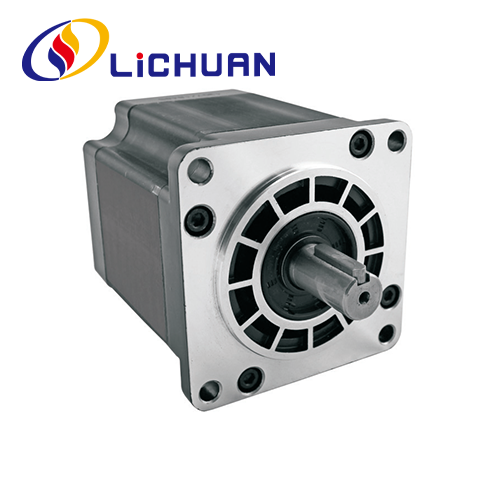
Table of Contents
- What Is a Hybrid Stepper Motor
- How Does a Hybrid Stepper Motor Work
- Main Structural Components
- Key Technical Parameters
- Advantages of Hybrid Stepper Motors
- Typical Industrial Applications
- Selection Guide for Buyers
- Frequently Asked Questions
What Is a Hybrid Stepper Motor
A hybrid stepper motor is a precision motion device that converts electrical pulse signals into mechanical movement. Each electrical pulse moves the motor shaft by a fixed step angle. This allows highly accurate positioning without requiring a complex feedback system.
The hybrid design combines two technologies:
- Permanent magnet motor structure
- Variable reluctance motor technology
By integrating these two designs, the motor delivers better torque, improved positioning accuracy, and smoother motion compared with traditional stepper motors.
Hybrid stepper motors produced by LICHUAN® are commonly used in CNC machines, 3D printers, textile machinery, and automated production equipment because of their reliability and precise motion control.
How Does a Hybrid Stepper Motor Work
The working principle of a hybrid stepper motor is based on electromagnetic interaction between the stator windings and the rotor magnetic field.
The operation process can be simplified into several steps:
- The motor driver sends electrical pulse signals to the motor coils.
- The stator coils generate a controlled magnetic field.
- The rotor aligns itself with the magnetic field.
- Each pulse moves the rotor by a fixed angle.
- Continuous pulses create rotational movement.
For example, a common hybrid stepper motor has a step angle of 1.8°. This means:
- 200 steps complete one full rotation
- Each pulse equals one step
- Precise position control is achieved through pulse counting
Because movement is controlled digitally, hybrid stepper motors are ideal for applications requiring exact positioning and repeatability.
Main Structural Components
A hybrid stepper motor contains several key components that work together to generate precise motion.
| Component | Description |
| Stator | The stationary outer part containing electromagnetic coils that create magnetic fields. |
| Rotor | A magnetized core with finely toothed structure that interacts with the stator field. |
| Bearings | Support the rotor shaft and ensure smooth rotation. |
| Shaft | The mechanical output component that transfers motion to external equipment. |
| Motor Housing | Protects internal components and dissipates heat during operation. |
The toothed rotor structure is one of the key features of hybrid stepper motors. It improves magnetic coupling and significantly increases torque output.
Key Technical Parameters
When selecting a hybrid stepper motor, engineers typically evaluate several performance parameters.
| Parameter | Typical Value |
| Step Angle | 1.8° or 0.9° |
| Holding Torque | 0.2 Nm – 12 Nm |
| Phase Number | 2 Phase or 3 Phase |
| Rated Current | 1A – 6A depending on model |
| Frame Size | NEMA 17, NEMA 23, NEMA 34 |
| Insulation Class | Class B or Class F |
These specifications determine motor performance in terms of speed, torque, heat dissipation, and load capability.
Advantages of Hybrid Stepper Motors
Hybrid stepper motors are widely used because they provide several significant advantages over other motion control technologies.
- High positioning accuracy
- Stable torque at low speeds
- Simple control through pulse signals
- Reliable open-loop control system
- Low maintenance requirements
- Cost-effective compared with servo systems
Motors manufactured by LICHUAN® are designed with optimized magnetic structures and advanced winding technology to ensure smooth operation and strong torque performance in demanding industrial environments.
Typical Industrial Applications
Hybrid stepper motors are used in many industries where precision motion control is required.
- CNC machine tools
- 3D printing systems
- Laser engraving machines
- Textile manufacturing equipment
- Medical instruments
- Packaging automation machines
- Semiconductor equipment
In these systems, the motor ensures precise positioning, synchronized motion, and stable production efficiency.
Selection Guide for Buyers
Choosing the correct hybrid stepper motor requires evaluating the specific requirements of the machine or automation system.
Important selection factors include:
- Required torque for the mechanical load
- Operating speed range
- Power supply and driver compatibility
- Installation size and mounting standard
- Environmental conditions such as temperature and vibration
Working with an experienced manufacturer like LICHUAN® ensures proper motor selection, stable driver integration, and long-term system reliability.
Frequently Asked Questions
1. What is the difference between a hybrid stepper motor and a standard stepper motor?
Hybrid stepper motors combine permanent magnet and variable reluctance technologies. This results in higher torque, smaller step angles, and improved positioning accuracy compared with traditional stepper motors.
2. Do hybrid stepper motors require feedback systems?
In many applications they operate in open-loop control without encoders. However, for high-speed or high-load environments, closed-loop systems can be added to improve performance.
3. What is the typical lifespan of a hybrid stepper motor?
With proper installation and operating conditions, a hybrid stepper motor can run reliably for tens of thousands of hours. Regular inspection of bearings and cooling conditions helps extend service life.
Conclusion
Hybrid stepper motors play a critical role in modern automation systems by delivering accurate, reliable, and repeatable motion control. Their combination of high torque, digital precision, and simple control architecture makes them suitable for a wide range of industrial equipment.
As automation technologies continue to evolve, selecting a high-quality motor becomes essential for ensuring stable machine performance. LICHUAN® provides professional hybrid stepper motor solutions designed for demanding industrial environments, helping manufacturers improve accuracy, efficiency, and operational reliability.
If you are looking for dependable motion control components for your machinery, contact us today to learn more about LICHUAN® hybrid stepper motor solutions and receive professional technical support for your project.