- English
- Español
- Português
- русский
- Français
- 日本語
- Deutsch
- tiếng Việt
- Italiano
- Nederlands
- ภาษาไทย
- Polski
- 한국어
- Svenska
- magyar
- Malay
- বাংলা ভাষার
- Dansk
- Suomi
- हिन्दी
- Pilipino
- Türkçe
- Gaeilge
- العربية
- Indonesia
- Norsk
- تمل
- český
- ελληνικά
- український
- Javanese
- فارسی
- தமிழ்
- తెలుగు
- नेपाली
- Burmese
- български
- ລາວ
- Latine
- Қазақша
- Euskal
- Azərbaycan
- Slovenský jazyk
- Македонски
- Lietuvos
- Eesti Keel
- Română
- Slovenski
- मराठी
- Srpski језик

How Does a Hybrid Stepper Motor Achieve High Torque and Precision
Have you ever found yourself deep in a project, needing a component that delivers both raw power and meticulous accuracy, and wondered what makes that possible? I know I have. In the world of automation, robotics, and precision machinery, the quest for a drive system that doesn’t force you to choose between strength and control is constant. That’s where the engineering marvel of the Hybrid Stepper Motor comes into play. For us at LICHUAN, this isn't just a product category; it's the core of solving our customers' most demanding motion control challenges. The unique design of a Hybrid Stepper Motor bridges the gap, offering the best of both worlds from other motor types, and today, I want to pull back the curtain on exactly how it accomplishes this feat. By understanding its inner workings and the precise parameters that define its performance, you can make an informed decision for your next application.
What Makes a Hybrid Stepper Motor Different from Other Types
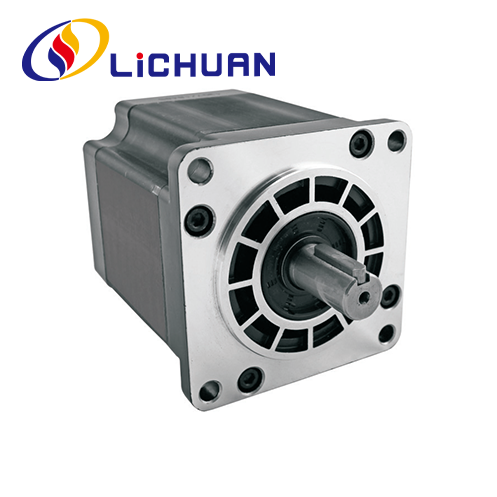
To appreciate its capabilities, we must first understand its identity. Unlike purely permanent magnet or variable reluctance steppers, a Hybrid Stepper Motor is, as the name implies, a hybrid. It ingeniously combines the principles of both. It features a permanent magnet in its rotor, but that rotor is also toothed, much like a variable reluctance motor. This fusion creates a synergistic effect. The permanent magnet provides a constant magnetic flux, boosting torque. Simultaneously, the toothed structure allows for a much smaller step angle—typically 1.8° or 0.9°—by enabling magnetic flux to take a preferred path through the aligned teeth. This combination is the fundamental reason a Hybrid Stepper Motor excels in applications requiring both high torque at low speeds and fine positional resolution.
How Does the Internal Design Create Superior Torque
The secret to the high torque lies in its magnetic circuit and air gap design. The stator of a Hybrid Stepper Motor has multiple toothed poles that are wound with coils. When these coils are energized in a specific sequence, they create electromagnetic poles. The permanent magnet rotor, already magnetized, is attracted or repelled by these stator poles. Because the rotor teeth are slightly offset from the stator teeth, the magnetic forces generate a strong tangential pull—torque—to align them. The more teeth and the stronger the magnetic flux (from both the permanent magnet and the coil excitation), the higher the torque. At LICHUAN, we optimize this by using high-energy permanent magnet materials and precision laminations to minimize flux losses and maximize torque density. This is why our motors can deliver exceptional holding and dynamic torque in a compact frame size.
Which Parameters Directly Impact Precision and Performance
Precision in a stepper motor is largely defined by its step angle accuracy and how consistently it can achieve those steps without missing. This is governed by several key technical parameters. Understanding these specs is crucial for selecting the right motor for your system's precision needs.
Key Performance Parameters of a Hybrid Stepper Motor
-
Step Angle: The angular displacement per input pulse (e.g., 1.8°, 0.9°). A smaller angle enables finer resolution.
-
Holding Torque: The maximum torque the motor can exert when energized at rest. This resists external forces.
-
Detent Torque: The slight torque present when the motor is unpowered, due to the permanent magnet and iron core attraction.
-
Accuracy: Typically a percentage of the step angle (e.g., ±5%). This is non-cumulative.
-
Step Repeatability: How precisely the motor returns to a commanded position, often extremely high.
-
Rotor Inertia: The inertia of the rotating part, affecting acceleration and deceleration dynamics.
Let's look at how some of these parameters translate in real-world LICHUAN models. The following table compares two popular series, highlighting how design choices affect torque and precision characteristics.
Table 1: LICHUAN Hybrid Stepper Motor Series Comparison
| Model Series | Frame Size (mm) | Step Angle | Typical Holding Torque Range | Key Design Feature | Ideal Application Focus |
|---|---|---|---|---|---|
| LC Series | NEMA 17 (42) | 1.8° | 0.4 - 0.6 Nm | Optimized magnetic circuit for smooth motion | 3D Printers, CNC Micro-milling, Optical Equipment |
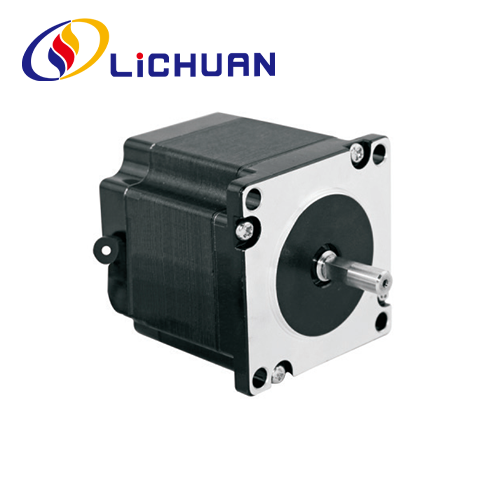
| HD Series | NEMA 23 (57) | 1.8° / 0.9° | 1.2 - 3.0 Nm | Robust construction & high-temp magnets | Industrial Automation, Packaging Machinery, Robotic Arms |
How Do You Select the Right Hybrid Stepper Motor for Your Application
Choosing the correct motor is a balance between your mechanical requirements and the motor's performance curve. The most common mistake is selecting based on frame size or holding torque alone. You must consider the speed-torque curve. A Hybrid Stepper Motor delivers maximum torque at low speeds, and torque decreases as speed increases due to the back-EMF and winding inductance. At LICHUAN, we guide our customers through a simple selection process:
-
Determine the load inertia and the required operational speed.
-
Calculate the acceleration torque and continuous running torque needed.
-
Review the speed-torque curve of a candidate motor, ensuring it provides at least 30-50% more torque than your calculated requirement across your desired speed range.
-
Match the driver’s current and voltage output to the motor’s phase specifications for optimal performance.
Table 2: Critical Selection Factors for Optimal Performance
| Your Application Requirement | Corresponding Motor Parameter | Why It Matters |
|---|---|---|
| Positioning Accuracy | Step Angle, Step Accuracy | Defines the smallest possible movement and its consistency. |
| Load Handling & Acceleration | Holding Torque, Rotor Inertia | Ensures the motor can start, stop, and hold the load reliably. |
| High-Speed Operation | Inductance, Winding Type (Bipolar) | Lower inductance allows faster current rise time, preserving torque at higher speeds. |
| System Responsiveness | Torque-to-Inertia Ratio | A higher ratio means faster acceleration for dynamic systems. |
| Thermal Management | Current Rating, Frame Material | Prevents overheating and ensures long-term reliability in duty cycles. |
What Are the Most Common Questions About Hybrid Stepper Motors (FAQ)
In our daily conversations with engineers and designers, certain questions arise repeatedly. Here are three detailed FAQs to address common curiosities and concerns.
FAQ 1: Can a Hybrid Stepper Motor run at high speeds like a servo?
While traditionally known for low-to-mid speed performance, modern Hybrid Stepper Motors, especially when paired with advanced microstepping drivers, can achieve surprisingly high speeds. The key is using a driver with high supply voltage to overcome the motor's inductance. However, for applications requiring sustained high speed with full torque, a servo system might still be more efficient. For many point-to-point positioning tasks with high torque needs at lower speeds, a Hybrid Stepper Motor offers a more cost-effective and simpler solution.
FAQ 2: How do I prevent missed steps and ensure precision?
Missed steps occur when the motor's load torque exceeds the available motor torque at a given speed. To ensure precision, always size your motor with a significant safety margin (see selection guide above). Use a closed-loop stepper system for critical applications—our LICHUAN closed-loop hybrids incorporate an encoder to detect and correct any step loss instantly, providing servo-like reliability without sacrificing the stepper's inherent simplicity and torque.
FAQ 3: Is microstepping necessary for achieving higher precision?
Microstepping is a driver technique that electronically divides a full step into smaller increments (e.g., 1/16, 1/32 of a step). It dramatically improves resolution, reduces vibration, and enables smoother motion, especially at low speeds. For ultimate precision and smoothness, pairing a high-quality Hybrid Stepper Motor with a microstepping driver is highly recommended. It allows you to leverage the motor's fundamental precision and achieve exceptionally fine and quiet operation.
Ready to Integrate Unmatched Torque and Precision into Your Design?
The journey to understanding the Hybrid Stepper Motor reveals a component built for performance where it counts. Its hybrid design is a testament to elegant engineering, solving the dual demands of power and accuracy in a single, robust package. At LICHUAN, we don't just manufacture these motors; we engineer them with a deep focus on the parameters that matter most to your project's success—from the magnetic material grade to the tolerance of every tooth.
If you’re navigating the complexities of a new design or optimizing an existing machine that demands reliability, strength, and pinpoint accuracy, let's talk. Our team is ready to help you analyze your requirements and match them with the perfect LICHUAN Hybrid Stepper Motor solution. Contact us today to discuss your specific torque and precision challenges. We're here to power your innovation, one precise step at a time.